

Best SAP Course for Engineers in 2026 (Mechanical, Civil, Electrical)

Look, let’s be honest — if you’re an engineer in 2026, the walls around any given field within your profession are basically non-existent. Whether you are working at a dusty construction site, a high-tech shop floor or overseeing a power grid, the “digital twin” of your project will now be just as important as the actual steel and wires. I’ve known a lot of brilliant engineers who have had a ceiling in their careers, not because they were not technical enough, but because they did not speak the “business language” that related their work to how it makes or loses money for the company.
And that is precisely why SAP is no longer a “nice to have.” Companies are no longer simply seeking someone who can operate a machine; they want the person who can master the data that comes out of it. And now that close to 75% of industrial companies are operating on AI-fueled SAP S/4HANA, just “being an engineer” is no longer the flex it once was. If you’re ready to fill that gap and take your career to the next level, these are the modules that will actually line up with your degree. Here in this blog, we provide you the best SAP course for Engineers in 2026, so stay tuned with this blog.
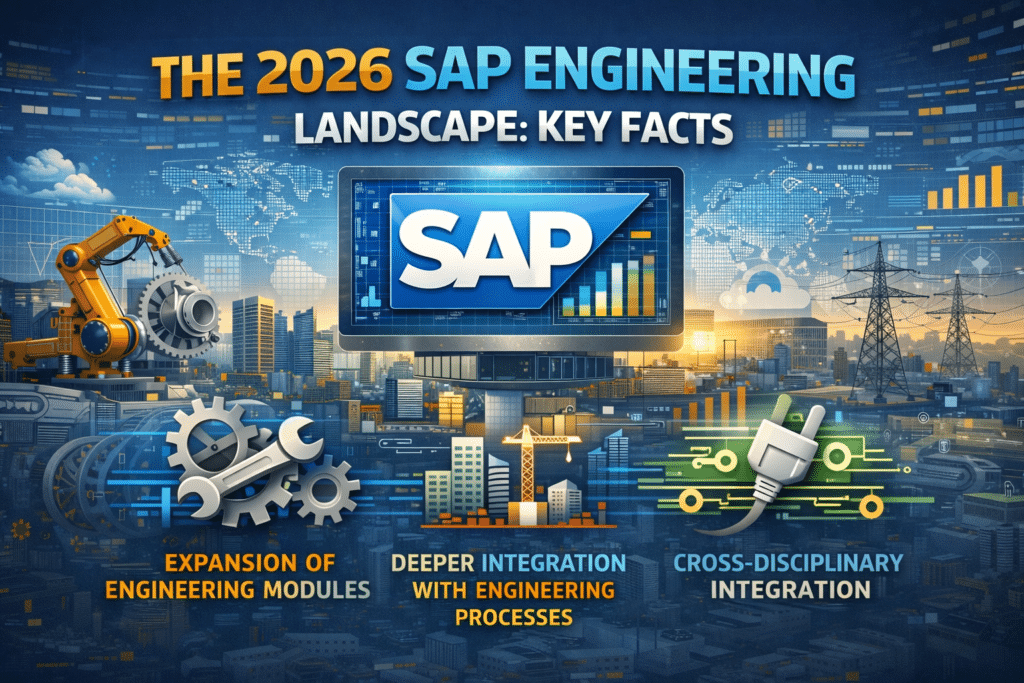
The 2026 SAP Engineering Landscape: Key Facts
But before we dissect these modules, let’s talk about the “why” for the change. Workload. There is, and has been for several years, a critical shortage of qualified engineering candidates, with an average ratio of three openings per one candidate.
- Market Dominance: The market leader for ERP in the world is still SAP, and there’s a huge push towards S/4HANA Cloud as support continues to move more toward the mainstream to get away from the older systems (ECC) out there.
- Salary Premium: SAP-certified engineers make on average between ₹15 lakhs and ₹27 lakhs, depending on the module and experience level in India.
- Industry Demand: Energy, Utilities, Construction, and High-Tech Manufacturing are predicted to be the top growing industries for SAP engineers in 2026.
- AI Integration: 75% of SaaS companies already use artificial intelligence automation in their SAP core business processes.
“The SAP ecosystem is in the midst of its most profound change since its inception. By 2026, we have moved from running operations to implementing intelligent business operations that are interconnected and interdependent.” — Industry Insights Report, 2026.
Top SAP Modules by Engineering Branch

Picking the right module is like picking a major in your last year; it should take what you already know and use that. This is what the 2026 market looks like for the best choices in each core engineering discipline.
1. For Mechanical Engineers: SAP PM & SAP MM
Mechanical engineers best in class modules: Physical assets, supply chain.
- SAP PM (Plant Maintenance): This is the “gold standard” for the mechanical folks. It covers the life cycle of hardware, preventive maintenance and recovery.
- SAP MM (Materials Management): A candidate can opt for this if the individual wants to work on the procurement and inventory side of manufacturing.
2. For Civil Engineers: SAP PS (Project Systems)
Civil engineering is a project-oriented field. SAP PS You can use SAP PS to manage large-scale infrastructure projects, including planning the project, executing on-the-ground tasks and costing as well. SAP PS consultants are in high demand by 2026 as the trend of data center construction and smart city projects has accelerated.
3. For Electrical Engineers: SAP PM & SAP EAM
Electrical Engineers typically will belong to SAP PM or EAM (Energy and utilities are a big area). The power grid and all the high voltage equipment involve a deep understanding of electrical theory as well as SAP structures.
Comparative Analysis: 2026 Stats & Salaries
Regarding Industry focus and average salary expectations estimated in 2026, here is a comparison for these modules in table format:
| SAP Module | Primary Engineering | Core Function | 2026 Avg. Salary |
| SAP PM | Mechanical/Electrical | Asset & Equipment Maintenance | ₹16.5 Lakhs |
| SAP PS | Civil/Project Eng. | Project Planning & Budgeting | ₹18.2 Lakhs |
| SAP MM | Mechanical/Industrial | Procurement & Inventory | ₹15.4 Lakhs |
| SAP PP | Mechanical | Production Planning | ₹17.0 Lakhs |
| SAP QM | All Branches | Quality Control & Inspection | ₹9.1 Lakhs |
Why Certification is Non-Negotiable in 2026
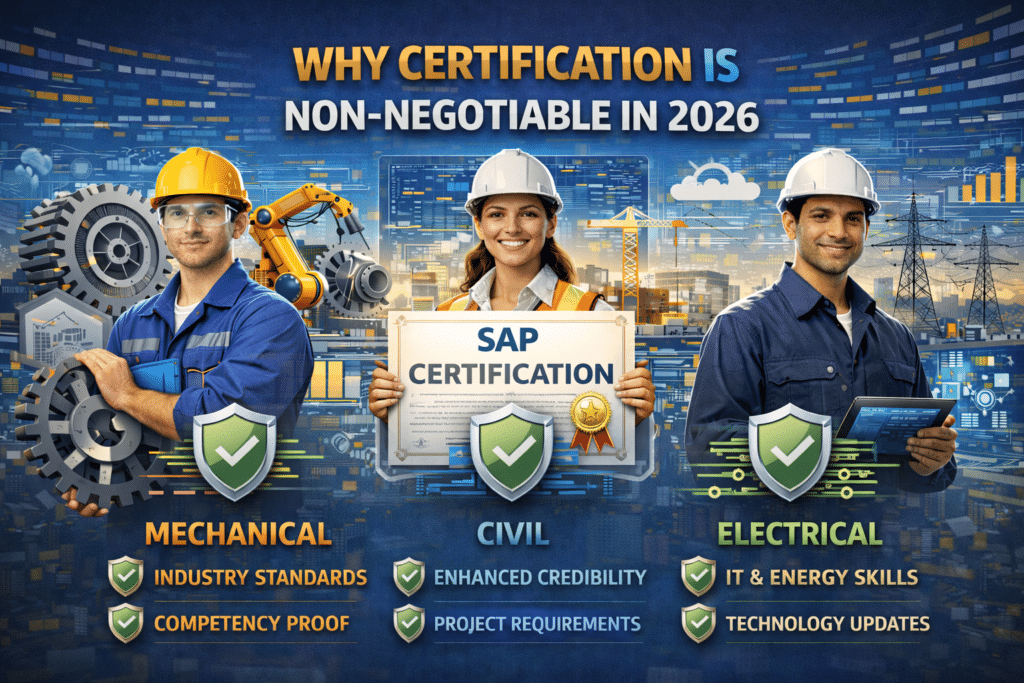
In 40-50 days, by 2026, your mid-to-senior engineering hiring cycle will have increased. Why? Because employers aren’t just seeking a degree; they’re looking for “precision hiring.” They seek candidates who fit precise technical requirements in a ”vanilla” SAP system.
“For ₹100 paid to a non-certified engineer, an SAP-certified professional in the same role can demand considerably higher pay because such professionals have this tool that lets them incorporate AI-based analytics into physical manufacturing processes.” — 2026 Workforce Planning Guide.
If you are an SAP-certified professional, it means that you know how to model carbon emission in the supply chain or integrate sustainability measures with your financial KPIs – skills which are no longer “optional” but mandatory for an engineer of tomorrow.
Conclusion
The road to making big bucks as a consultant or senior project manager in 2026 goes right through being digitally savvy. Now the options for hatching a lucrative career are limitless, whether you are a Mechanical engineer wanting to make headways into SAP PM, a civil engineer aspiring towards SAP PS, or perhaps an electrical engineer being enchanted by the energy savings delivered through SAP EAM. The distance between physical engineering and digital administration has shrunk, and people who can bridge this gap will soon be in control.
To ensure you are not left behind by these trends and can position yourself for success in the future of Industry 4.0, you need a partner who knows both the technology and your career. That’s where Nextnow enters the picture; it helps you with your way through these intricate certifications and makes sure that your engineering foundation is enriched with the freshest SAP relevance for the years to come.
FAQs
I’m a Civil Engineer—why on earth do I need SAP?
Consider it: You aren’t just constructing a bridge; you are the boss of some multi-crore project with over a thousand moving parts, vendors and deadlines. SAP PS (Project Systems) is the mastermind behind a construction project. It records every brick purchased and every hour billed. In 2026, the leading infrastructure companies will not consider a Project Manager candidate who can’t operate an ERP system.
Is it true that SAP exams have changed? Can’t I just memorize the answers?
Definitely not anymore. From the end of 2025, SAP switched to performance-based exams. Which means you have to log into a system and really solve a problem or perhaps talk with an AI avatar, something that demonstrates your expertise. It’s “open book” now, but that’s because they’re testing your logic rather than your memory.
I already have a busy job. How long does this actually take?
By and large, most engineers can be “job-ready” in somewhere from 8 to 12 weeks if they work at it a little every day. For a full certification, expect to spend about 3-6 months of part-time study. The good news? Now most of the learning is tactile, in the form of simulations — so it feels more like doing and less like a boring lecture.
Which pays more: staying a “Pure Engineer” or switching to SAP Consulting?
It’s the Hybrid Engineer, in fact, that is the “sweet spot.” Salary trends in 2026: a mechanical engineer, who recognizes the physical machine and also knows the SAP Data, accumulates 30-40% more than someone who controls one of these two areas. You don’t have to abandon engineering; you’re just promoting it to a digital medium.
Will AI replace the need for SAP consultants by the end of 2026?
Intelligence (e.g. SAP Joule) is making these consultants more valuable than ever. These days, there’s plenty of data for A.I. to crunch, but few engineers who can tell machines whether the results make sense in the real world. Companies are looking to staff people who can “prompt” the AI and validate what happens within the SAP ecosystem.