

25 Real SAP MM Interview Questions Asked by Canadian Employers
Industries like manufacturing, retail, logistics, healthcare, and energy sectors significantly depend on SAP Materials Management (SAP MM) to effectively oversee all tasks related to procurement, inventory and vendor management, and supply chain operations. As more businesses implement SAP S/4HANA, employers look for candidates possessing good knowledge of both the technical and business side of SAP MM.
If you are applying for a junior SAP MM consultant position or an experienced SAP functional consultant position, being prepared for real interview questions can increase your chances of success.
In this blog, we will talk about the 25 real SAP MM interview questions that are regularly asked by Canadian employers.
25 Real SAP MM Interview Questions

1. Can you describe the Procure-to-Pay (P2P) process in SAP MP?
Here, the interviewer is testing your understanding of the overall procurement process covering everything including how a purchase requisition comes into being until a payment to a vendor is executed.
2. What’s the difference between a purchase requisition and a purchase order?
You should define that a Purchase requisition (PR) is an internal demand for goods or services to be bought while a Purchase order (PO) is the document that should be sent to a supplier.
3. What procurement types does SAP MM cover?
You should name internal procurement, external procurement, subcontracting, stock transfer, and consignment procurement.
4. How does SAP MM mesh well with other SAP modules?
Employers look for candidates who can talk about integration with:
- SAP SD
- SAP FI
- SAP PP
- SAP WM or EWM
- SAP QM
Please explain how inventory and financial postings are posted automatically between modules.
5. What does the term Movement types mean in SAP MM?
Explain that movement types represent the reasons for inventory transactions. For example, they include:
- 101 – goods receipt
- 201 – goods issues
- 261 – goods issues for the production
- 311 – stock transfer
Note that each movement type carries out a control of stocks and accounting operations.
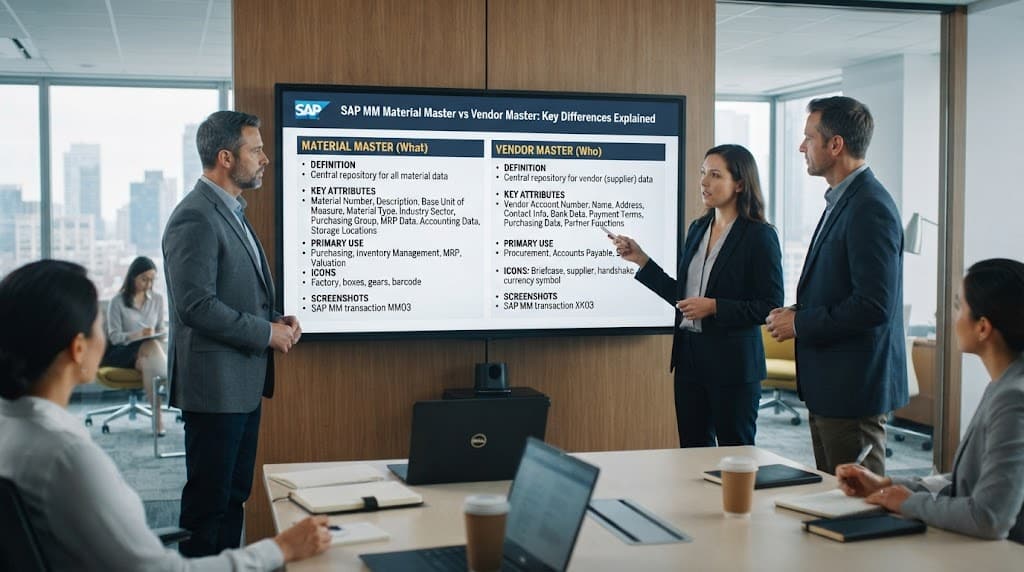
6. What’s the purpose of the Material Master?
Indicate that the Material Master keeps data needed for purchasing functions, inventory management, accounting, planning, and sales.
7. What are the several views that can be found in the Material Master?
The following views are among the most common ones:
- Basic data
- Purchasing
- Accounting
- MRP
- Plant data
- Storage
- Sales
- Costing
8. Explain Vendor Master in SAP MM?
Describe what vendor master records are and what information they store about the suppliers, including purchasing information, p
Payment terms, addresses, and accounting data.
9. What is Source Determination?
Explain how SAP helps in “finding” a supplier automatically based on source lists, quota arrangements, contracts, and scheduling agreements.
10. What does the Release strategy mean?
Discuss how release strategies provide automated approval workflows for a purchase request and a purchase order according to their value or department.
11. What is meant by RFQ?
Explain that RFQs enable the companies to receive various pricing proposals and conditions from different suppliers.
12. Differentiate between Contract and Scheduling Agreement
A contract specifies the long-term terms of purchasing while a scheduling agreement provides the delivery schedule of the purchased goods.
13. What is Goods Receipt?
Explain that Goods Receipt indicates that the ordered materials were received and automatically updates the inventory.
14. What is meant by Invoice Verification?
The interviewers expect the candidates to explain the three-way matching process,
- Purchase Order
- Goods Receipt
- Vendor Invoice
In order to guarantee correct payment processing.
15. What is Physical Inventory in SAP MM?
Determine how the physical inventory enables the companies to check their real stock against the data in SAP.
16. Define Split Valuation?
Define how the single material can have several valuation methods e.g. domestically produced and imported versions.
17. What is meant by Batch Management?
Explain what batch processing means and how this facilitates the company with identification of product by production or expiration date.
18. What is an Info Record?
Explain that Purchasing Info Records provides the information concerning any vendor in terms of his prices and delivery terms.
19. What is the process of developing and keeping a Source List in SAP MM?
A Source List is prepared for transportation and suppliers to determine which vendors are ready to supply the items. The Source List contains information about suppliers, validity terms, procuring organization, and whether the source is mandatory or blocked (ineligible to send the products). If the Source List is updated properly, SAP will find the correct supplier for the procurement.
20. Do you have experience working in SAP S/4HANA?
There is a trend with employers from Canada who are moving from SAP ECC towards SAP S/4HANA.
21. Tell us about a procurement problem that was particularly demanding for you.
HR professionals often request real-life examples.
As far as your structure is concerned, you can either use the STAR approach:
- Situation
- Task
- Action
- Result.
The main goal should be measurable improvements in the business sphere.
22. How do you deal with discrepancies with suppliers?
Please describe your way of:
- Checking purchase orders
- Checking receipts
- Comparing invoices
- Interacting with finance and purchasing departments
- Solving problems before making payments.
23. What reports are used by you in SAP MM?
The reports are as follows:
- Inventory
- Purchase orders
- Vendors performance
- Stock valuation
- Material consumption
- Open requisitions
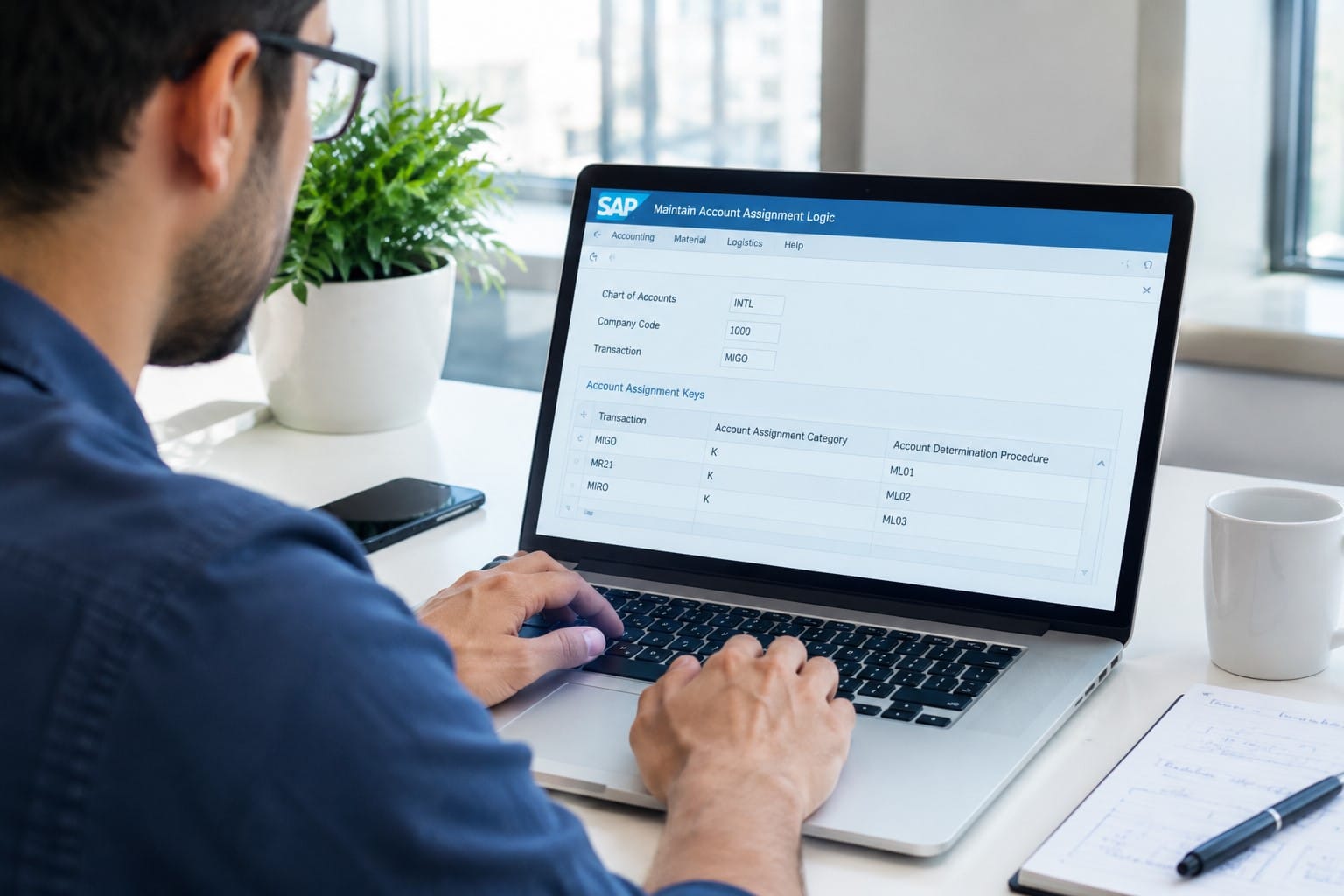
24. What is the importance of automatic account determination in SAP?
You have to explain that it is through valuation classes and account determination settings that the accounting registries are made by the system automatically.
25. Why would you like to be employed as an SAP MM consultant in Canada?
Employers are interested in this question to understand your career expectations.
When answering it, mention that you would like to help companies transform and improve their procurement processes using SAP.
Tips to Prepare for an SAP MM Interview in Canada
Canadian employers, in addition to expertise, are interested in candidates’ communication skills and problem-solving capabilities. Keep in mind these tips:
- Learn overall procurement processes.
- Make sure you can explain business cases instead of just repeating definitions.
- Learn the most important transaction codes in SAP MM.
- Try to gain as much information as possible about the system.
Blockquote
“Success in SAP MM interviews isn’t about memorizing answers—it’s about demonstrating how you solve real-world procurement, inventory, and supply chain challenges with confidence.”
Final thoughts
It is not enough to simply learn SAP terminology when preparing for an SAP MM interview. Employers in Canada are looking for professionals who can apply their knowledge of SAP MM to actual business situations, address procurement issues, and work with different units of the company. Preparation for an SAP MM interview involves answering the 25 sample questions given below, gaining an understanding of important procurement concepts, and talking about your experience with projects.
Nextnow is a top SAP institute in Canada to provide the highest quality SAP training to students and employees. Feel free to know more in detail about the courses provided by them.
Contact details
Company name – Nextnow
Phone no – +1 365-341-2985
Email ID – admin@nextnow.ca
Address – 2 County Court Boulevard, Suite 400, Brampton, ON, L6W 3W8, CANADA
Frequently Asked Questions
1. What are the most popular topics of SAP MM interviews in Canada?
Employers in Canada usually ask questions about the following subjects: procurement, inventory management, SAP S/4HANA, vendor management, material master, and integration with other SAP modules.
2. Is it important to know about SAP S/4HANA while doing SAP MM jobs in Canada?
Yes, many businesses are currently shifting to SAP S/4HANA and knowledge of its procurement features and Fiori applications is very beneficial.
3. Do employers in Canada prefer certified SAP MM professionals over experienced ones?
Although practical experience is generally favored, SAP certification can add points to the candidate’s resume.
4. Which SAP MM transaction codes should I learn for the interview?
The most popular transaction codes are ME21N, ME51N, MIGO, MIRO, MMBE, ME23N, MB52.
5) Where can I get the interview preparation and certification for the SAP MM?
Nextnow is a trusted and reputed SAP institute in Canada that provides the best SAP education and training to employees.