

SAP MM Material Master vs Vendor Master: Key Differences Explained
If you’ve just begun your SAP MM journey, these two terms might have already caught you completely off guard! We’ve all been there – both “master data” objects are very similar in the way they are created, both are created before you can transact them, and both of them feature heavily in daily procurement processes. But in reality, they are very different and actually have very different purposes in SAP MM – one is for what you buy, and the other is for who you buy it from. Once you understand this difference, a lot of SAP MM will start to come together, and this blog will give you an insight into how Material Master and Vendor Master differ, and why it matters if you’re planning SAP Training or SAP Certification.
What Is Material Master Data Used For in SAP MM

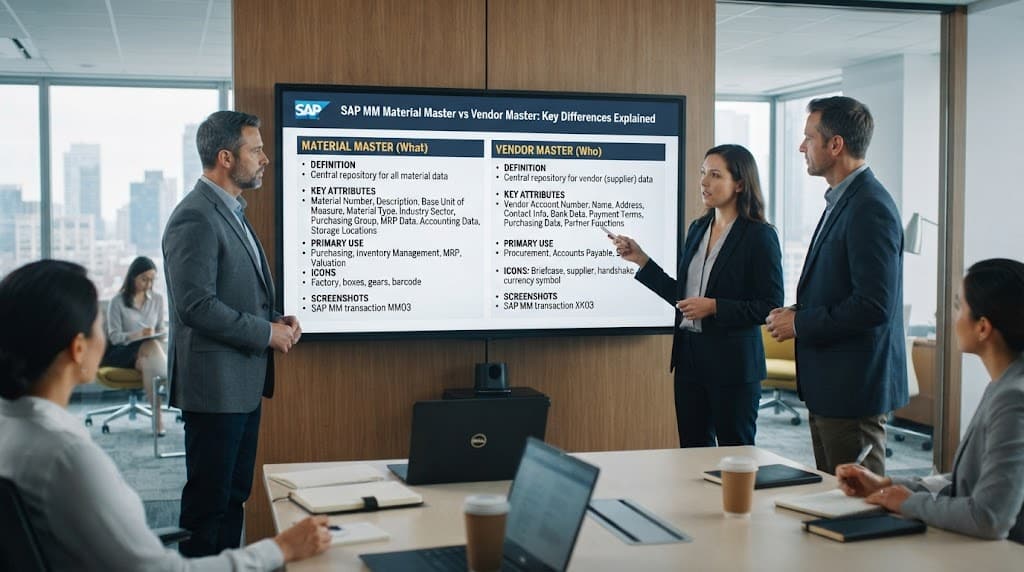
Material Master is the central information repository for all data relating to any material that a company buys, makes, stores and sells. Information such as the material type, the base unit of measure, the valuation class, plant specific details, storage location related details and the purchase-related details are stored here.
As different departments require different details about the same material, Material Master is organised into views Basic Data, Purchasing, MRP, Accounting, Storage etc. so that only those fields that are required for a particular department are available. Without a data record in the Material Master, you cannot create a purchase order, cannot run the MRP and cannot post a goods movement for that material.
What Is Vendor Master Data Used For in SAP MM

Vendor Master Stores all the records associated with the supplier aspect of the transaction – accounting view, company code data, purchasing organisation data, bank details, payment terms, vendor tax details, contact data. Vendor master is stored between FI and MM, which is the reason why your vendor master records have both a purchasing view and an FI accounting view. You need a Vendor Master for each of your vendors, whether they are a raw material supplier or a services provider, before you can raise a PO, they can be invoiced, or you can release a payment to them.
How Material Master and Vendor Master Structurally Differ
The most significant difference is what each one represents. Material Master is based on the “what” – what the item is. Vendor Master is based on the “who” – which business partner supplies the good or service regardless of the materials supplied.
For any given material, you can attach a number of different vendors through the Purchasing Info Record; for any given vendor, you can attach dozens of materials through a Purchasing Info Record. This many-to-many relationship is handled independently of either of the master records, and many beginners stumble over this fact early in their SAP Course.
Where These Two Objects Intersect in Real Procurement Processes
Even though they are two different masters, they are coupled together all the time on real transactions. When you create a purchase order, SAP loads plant/valuation information in the Material Master and simultaneously loads vendor payment/tax information from the Vendor Master. Info Records are the cross-over point and maintain the vendor-specific pricing and lead time for a material. This intersection is the divide between someone who can press buttons in SAP and someone who understands the procurement cycle, start to finish.
Common Mistakes Beginners Make With These Two Master Data Objects
An easy ‘first timer’ mistake is to think that correcting a problem in Material Master will automatically resolve a vendor problem, or vice versa. For example, pricing issues are often caused by the Info Record or the Vendor Master (not the Material Master). Or not being sure to maintain all of the views necessary for company code data for a vendor, or all views necessary for material master data for a material, means that purchase order or invoice processing can unexpectedly fail. Learning a set of real-world practical, scenario-based problems that can be avoided with an SAP Training program helps avoid the very sorts of problems you may encounter ‘in the field’.
Why This Distinction Matters for Your SAP Career
This is another thing recruiters and project managers are really expecting SAP MM consultants to be experts in because it is the focus of virtually every interview and project you will do. Understanding the relationship between the Material Master and the Vendor Master – not just conceptually, but practically – through configuration is one of the surest-fire indicators you’re ready for client-facing SAP work. It’s also one of the earliest things any good SAP Certification guide will dig into because it’s the basis of SAP procurement, inventory and invoice verification.
Bringing the Two Together the Right Way
Material Master and Vendor Master aren’t opposing schools of thought – they are simply two components of procurement and you need to understand how they can complement each other if you want SAP MM to make sense for beginners. Would you like to go beyond textbook definitions and just do your SAP configuration, purchasing cycle, vendor-material integration and the rest of the job yourself? Purchase SAP Training from Nextnow!
FAQs
Do I need to create Material Master before Vendor Master, or does the order not matter?
The sequence isn’t really significant – they’re completely separate objects. You could have a Vendor Master record with no Material Master record; or the reverse, no vendor specified for a Material Master record. They are only joined, at a later date, using a Purchasing Info Record, or on the purchase order itself.
Can one material have multiple vendors, or is it always a one-to-one link?
Definitely! This is a very common real-world scenario- you rarely have one vendor that supplies a key material. The relationship between a vendor and a material is actually controlled in the Info Record, not the Material Master or the Vendor Master!
Why does Vendor Master have both a purchasing view and an accounting view?
Since the Vendor Master data is shared between MM and FI, we want to give the purchasing view things like purchasing organisation data and order currency and give the accounting view things like reconciliation account and payment terms. Both require their own side of the same Vendor record which is why it’s broken this way.
If I mess up a field in Material Master, will it break my purchase orders?
Yes, depending on the area. As one of the most common reasons for purchase orders or MRP runs failing for those just starting out is that information within views such as Purchasing or MRP is either incorrect or not present. Just a helpful reminder of why we should know the views rather than just definitions!