

SAP Course Eligibility Criteria Explained
Why is it that some people glide effortlessly into tech and others are stuck at the door in their job transition? A well-timed SAP Course is typically the answer. If you’ve been looking for jobs on job boards you’ll have noticed that knowledge of SAP isn’t just “nice to have”, it is now regarded as a huge leverage to help you in your career search. So before you jump into the world of Enterprise Resource Planning (ERP) a major question is, “Am I qualified?” Whether you are a new graduate trying to find your bearings or an experienced professional trying to make it to the next step, you need to figure out what is necessary for you to get SAP training. So, here in this blog, we give you the information about the SAP course eligibility criteria explained.
What is SAP, and Why the Hype?
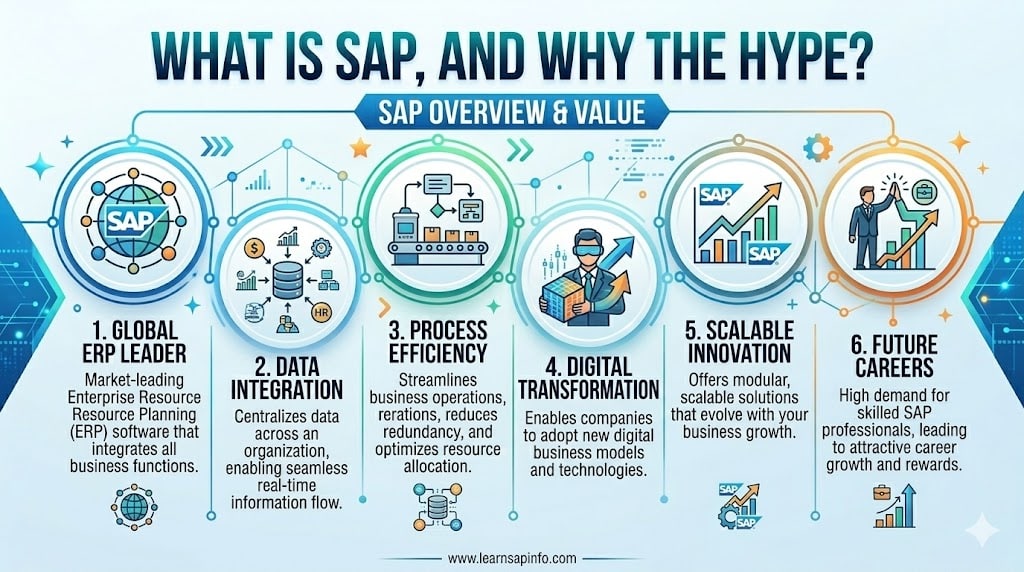
Before discussing who is involved, let’s examine the SAP definition. SAP means Systems Applications and Products in Data Processing. In layman’s terms, it is the top worldwide business operation software application product; thus there is very high demand for certified individuals as nearly every Fortune 500 company utilizes SAP. The SAP Course is more than just learning how to use SAP; it is also an education about the operation of global companies.
General Eligibility: The Baseline
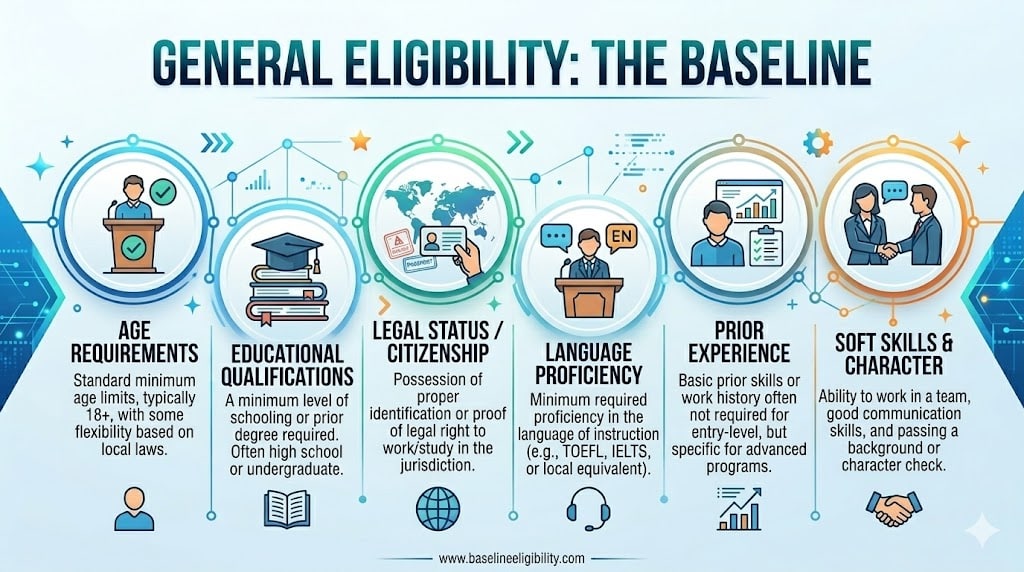
Inclusivity is one of the best aspects of SAP. There is an opportunity for everyone in SAP, unlike other technical fields, where you may need to be a code genius to get ahead. To ensure you are able to work through the program and complete the duties of your future position, a couple of minimum requirements are:
- Educational Background: Most employers/educational institutions require that you have at least a bachelor’s degree. Whether you have a B.Com, B.Sc, B.E., or BBA, having an educational degree shows that you possess the necessary fundamental analytical skills to succeed.
- Basic Computer Skills: You do not have to be a programmer to work in SAP (unless you are choosing a technical module) but you must be comfortable with working in and navigating through various software systems as well as using the basic tools associated with Microsoft Excel.
- Business Process Knowledge: A basic understanding of how a business operates, like how sales are generated and how inventory is stocked provides you with the foundational knowledge which will make it easier for you to be successful in SAP training.
Choosing Your Path: Module-Specific Eligibility
There are two types of SAP modules: Functional Modules (Business side) and Technical Modules (IT side). Depending on experience, 1 will be perfect for you.
1. Functional Modules (The Business Side)
- SAP FICO (Finance & Controlling) – Great for B.Com, M.Com, CA, MBA Finance Graduates. If you like Balance Sheets, you have found your niche.
- SAP MM (Materials Management) – Great for Supply Chain, Logistics, and Mechanical Engineering backgrounds.
- SAP HR/HCM (Human Capital Management) – Great for Human Resource Professionals or MBA HR Graduates.
- SAP SD (Sales and Distribution) – Great for Marketing Professionals with Sales & Retail experience.
2. Technical Modules (The IT Side)
This is for the individuals who create from “the ground up/under the hood”:
- SAP ABAP – Is the SAP code, if you have a B.Tech or MCA and are familiar with basic Java or C++. Then this section can be applied to you.
- SAP BASIS – This relates to system administration with an emphasis on database management, it is considered the “IT Support” of the SAP environment.
Why Aim for SAP Certification?
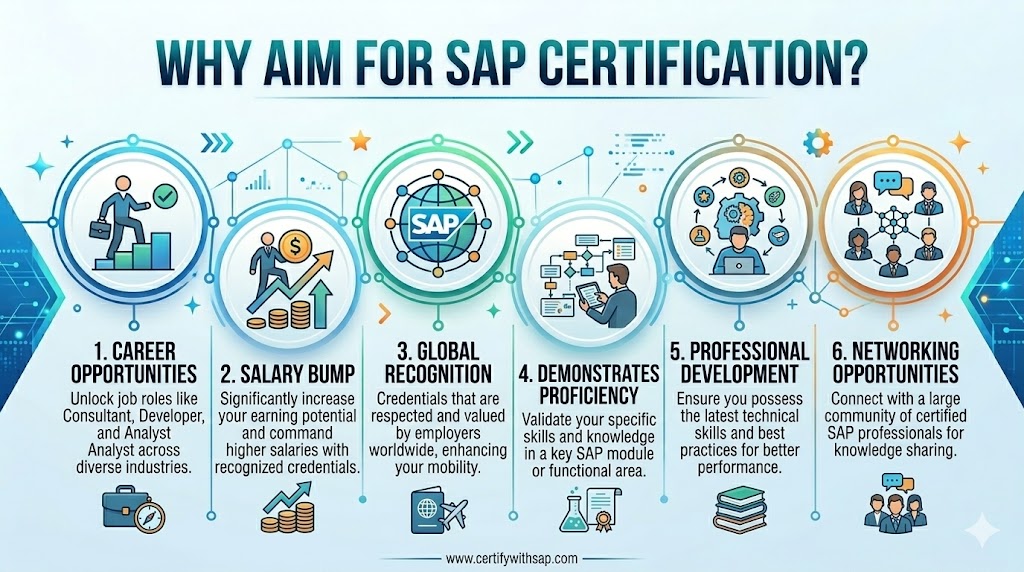
Although you can learn the SAP software without needing a certificate from SAP, you will have software to the international job market if you obtain an official SAP Certification. This is why an SAP Certification will be important in 2026:
- Validation – Your certificate will show prospective employers that you have skill sets matching the worldwide SAP standards.
- Pay Raises – SAP Certified professionals earn 20%-30% higher than their non-certified co-workers on average.
- Global Mobility – Whether you’re seeking employment in New York City or Mumbai, SAP will be the same everywhere around the globe. Your SAP Certification will have the same value wherever you choose to work internationally.
| Feature | Without Certification | With SAP Certification |
| Job Market Standing | General Applicant | Verified Specialist |
| Salary Potential | Standard | Premium |
| Skill Recognition | Local/Company-specific | Global |
Prerequisite Checklist for 2026
This checklist will help with your enrollment for this year.
- Keep your degree certificate (graduation/post-graduation) ready.
- If you are a fresher, research the basic principles of your chosen field.
- (e.g. Understanding what a ‘General Ledger’ means before working with FICO).
- Keep time for studying for two or three months dedicated to your coursework because SAP is used all over the world, being able to read and write English will help prepare for the exam and communicate in the workplace.
Conclusion
Becoming an expert at SAP is a long process (a marathon) and not a quick or easy one (sprint), so the first step is identifying the appropriate SAP Course based on your previous education and relevant interests. When you use this knowledge about your strengths and apply it to the appropriate SAP Course, it will make the career climb much more manageable and easier (as you approach each level one step at a time).
Nextnow can provide you with the best experts, hands-on experience and a program specifically designed to prepare you for success once you are placed in an SAP career. From determining the right module based on your current skills to passing your certification, we ensure you don’t just learn but you are also great at what you do.
FAQs
Can I do SAP right after 12th grade?
You can complete the training program; skipping a diploma isn’t advised. Most businesses that hire SAP specialists require their candidates to have at least a Bachelor’s degree. The exceptional time to pursue SAP studies is during your very last year of university or when you complete your degree.
Is it possible to learn SAP without a degree?
The road has a steeper slope. If you have a sizeable area revel in (e.G., 5 years in warehouse control or accounting), you may transition into SAP MM or FICO without a degree. Your real-world expertise of commercial enterprise processes becomes your number one qualification.
Do I need to know how to code?
You ought to choose Technical Modules which encompass SAP ABAP and SAP Fiori to get entry to this unique requirement. The Functional Modules FICO MM SD do now not require you to write down code at all. The gadget configuration requires you to have a “logical attitude” so one can allow you to fulfill commercial enterprise necessities.
Can “Freshers” actually get jobs in 2026?
The demand for Associate Level consultants is currently excessive because organizations are transitioning their operations to cloud-based totally S/4HANA structures. The most effective approach for a newbie to demonstrate their readiness for employment is to acquire an reputable SAP Global Certification.