

How Hands-On Projects Improve SAP Training Outcomes
In today’s booming digital economy, SAP training isn’t just a nice-to-have — it’s critical for companies looking to maximize their ERP spend. However, classic analytic education is frequently insufficient when students require practical adeptness in the utilization of elaborate business processes. That’s where hands-on projects and applied learning come into their own. Studies have indicated that formal learning enhances performance by 23% while informal, on-the-job activities boost it by as much as 32%, indicating that experience-based learning gives many tangible results.
In this blog post, we take a deep dive into why hands-on projects make such a significant impact on the effectiveness of SAP training – from higher user adoption and fewer support tickets to quicker ROI and more confident users. In this post, we’re going to discuss several key advantages of theoretical learning versus practical application, break down different training methods, review real-world data and thoughts from experts that suggest the value in combining these two forms of education.
Why Hands-On SAP Training Matters

Here are some core points that emphasize just how big a difference practical learning can make when it comes to SAP:
- That’s why it is believed that formal training only increases performance by 23.7% and informal/hands-on learning can boost the organizational performance by up to 32%.
- Companies that concentrate on real applications usually notice a 35% decrease in support tickets after training.
- Following their training, 85 percent of employees feel confident working with SAP in everyday operations — a vital factor for user adoption.
- Goal-aligned training could also reduce onboarding cycles as well as diminish deployment times by considerable lengths to hasten ROI.
Put simply, learning by doing is more than just a buzzword — and it stands on measurable improvements that engage both employees and the organizations supporting them.
The Hands-On Advantage: What Makes It Work?
1. Real Application Trumps Theory Alone
The theoretical foundations are usually taught in the classroom using slides. But SAP systems have an impact on real business processes. When learners have not had hands-on experience, they tend to forget the steps or fail to use them under stress.
“Hands-on training translates knowledge into proficiency — learners not only know SAP; they work confidently in it.”
With hands-on labs, scenario-based simulations and sandboxes, developers experiment and learn by making mistakes in a low-stakes environment — a perfect formula for stronger learning retention and faster implementation.
Comparing SAP Training Approaches

| Aspect | Traditional Training | Hands-On Project-Based Training |
| Engagement Level | Medium | High |
| Knowledge Retention | Moderate | High |
| Application in Real Taska | Low | Very High |
| Support Ticket Reduction | Modest | Significant |
| User Confidence Post-Training | Variable | Consistently Higher |
| Time to Productivity | Slowest | Faster |
Hands-on methods lead to muscle memory – by repeatedly completing tasks in simulated case studies, people absorb the process that would normally require frequent support or supervision.
Evidence From the Field: SAP Training Metrics
To demonstrate how SAP training results for you are better with applied methods, sample these actual training effect numbers:
| Training Metic | Result After Practical SAP Training |
| Post-training confidence | 85% enough comfortable using SAP in day-to-day activities |
| IT support ticket reduction | 35% fewer help requests |
| Certification pass rate | ~80% on first attempt |
| Average assessment improvement | From 50% to 87% scores |
| Long-term productivity improvement | Up to 30% time savings on tasks |
These numbers indicate not just learning gains but business value — where training flows directly into lower operational friction and greater efficiency.
How Hands-On Projects Build Real Skills
Here’s why experiential SAP training is so effective at teaching:
- Scenario-Based Simulation – Simulations reflect actual business scenarios (for example, end of financial period, order processing), enabling learners to practice by performing whole processes themselves with instant feedback. These simulations thus serve to bridge the theoretical-practical divide.
- Role-Specific Task Practice – Modules in place of generic instruction Packages are Dan Moore. These modules placed user roles (operations, finance, HR) “hands-on” to empower them to confidently execute their tasks.
- Immediate Application and Reflection – Learners perform transactions, diagnose situations and ponder the consequences — a formidable combination for solidifying knowledge and instilling problem-solving habits.
Voices From Training Experts
“Hands-on, structured sessions allow you to internalize a lot of learning quickly and have been shown to reduce time-to-proficiency — something that is at a premium in complicated systems like SAP.”
Experts in the field of training underline that being involved and participating is what leads to mastery, not passive listening.
Overcoming SAP Training Challenges With Hands-On Learning
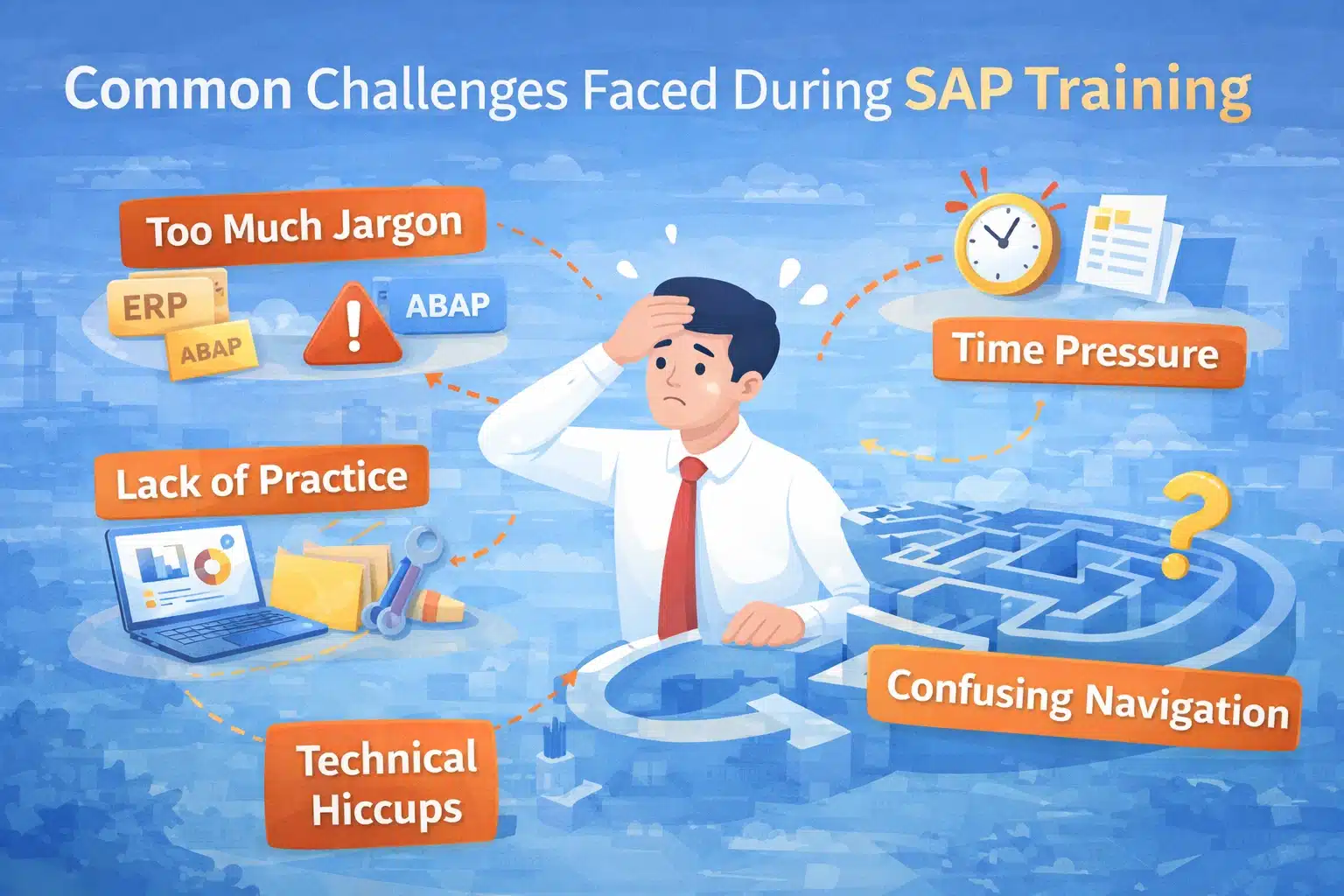
On-the-job training also addresses some typical obstacles that can arise in the adoption of SAP:
- Skill Gaps: By training with hands-on practices, users get a chance to cover real gaps which they can’t cover in theoretical sessions.
- Resistance to Change: Confident people are less afraid of change, so a ‘dynamic’ relationship with tasks builds confidence.
- Data Risk Concerns: Learning in sandboxes eliminates the risk of live system errors and get to play with business logic.
These benefits make hands-on practice an integral part of SAP onboarding and ongoing learning.
Best Practices for Implementing Hands-On SAP Training
Make the best of your SAP Training:
- Use Sandbox or Test Environments – Offer a safe environment for them to practice on without affecting live datasets.
- Integrate Real Business Scenarios – Design tasks similar to the kind of work a user will do on a daily basis.
- Blended Learning Mix – Combine theory with project work, simulations and role playing. Exercise the skill.
- Measure and Track Outcomes – Compare Pre and Post-training Survey data, Confidence levels and Monk support ticket volumes over time.
Conclusion
Our hands-on SAP training results in higher user confidence, lower support and training costs and substantially improved productivity from your SAP users immediately after our courses. Whether in simulations, through sandbox exercises or in real-world scenario labs, experiential learning ensures a smooth transition between ‘knowing’ and performing.
By adopting workable learning solutions and integrating them into your SAP training methodology, your company can help learners gain the most significant competency and bring down the cost of ERP implementation.
For companies needing to raise their employees’ knowledge and support your journey in the digital transformation, Nextnow provides you with personalized training paths and solutions that combine learning by doing with measurable impact -empowering people to get the most out of SAP.
FAQs
Is The Hands-On SAP Training For Beginners?
Absolutely. Hands-on projects can be particularly beneficial for beginners as they will help overcome the fear of touching SAP. Training system environments are a safe place for learners to practice, make mistakes and not impact live business data.
What is hands-on SAP training compared to classroom training?
Typical training tends to be theory, slides and demonstrations. SAP Hands-on training takes it a step ahead, offering learners the ability to actually perform the tasks. This hands-on nature explains higher retention, quicker learning, and greater confidence.
Does hands-on SAP training help to decrease support tickets and errors?
Yes. When users are trained in real-world scenarios in order to use SAP, they will have a far greater comprehension of workflows and make fewer errors post-go-live. Help-desk requests and reliance on IT support are often significantly reduced for companies.
Is hands-on SAP training useful for certification exams?
Yes. Students who practice SAP tasks through real-world scenarios are more likely to successfully pass certification tests. Experience gives them a better sense of how ideas get used, which in turn makes it easier to answer scenario-based questions.