

How AI Is Changing SAP Careers
Let’s take one moment of honesty: if you’ve been part of the SAP ecosystem long enough to remember, then you’ve likely experienced the transformation of our world. Years ago—before we had to deal with SAP’s various T-code systems, problematic manual configurations and lots of late nights trying to troubleshoot the old ECC kernel—the title of “SAP Expert” meant something very different than it does today. Now, if you walk into any place that’s involved in implementing and providing SAP solutions, you will likely hear conversations about things like utilizing SAP Business AI or deploying a Joule copilot to support month-end close automation vs. simply keeping the lights on. So if you’re feeling like “wow, this is exciting! But wait… do I need to now learn to program in Python?”, have no fear; you’re not alone! While the traditional SAP career path is not disappearing, it’s being RENEWED through the power of AI, providing even more opportunities than before. The positive effect of this change will result in our roles becoming much less focused on repetitive data entry, and much more focused on managing top-level strategy. So here in this blog, we provide you the complete information of How AI Is Changing SAP Careers.
The End of “Button-Pushing” Careers
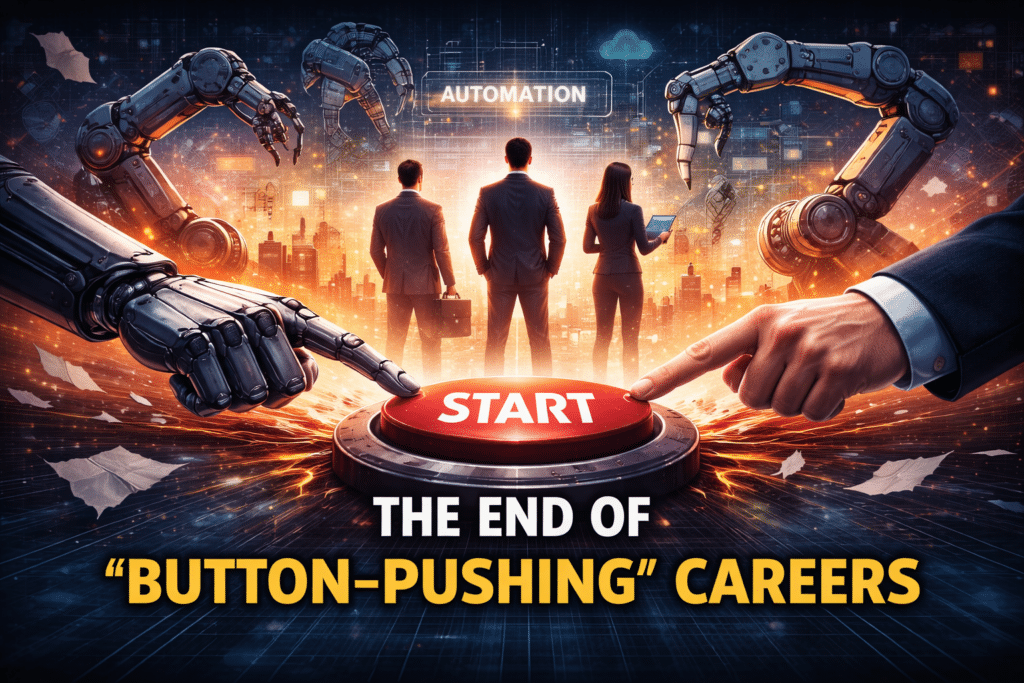
Traditionally, many SAP roles have been transactional (for example, manual invoice matching, basic report generation) until industry changes in 2026 prompt AI to start doing these “robotics” tasks. SAP systems will now have the ability to do “Financial Reconciliation” and “ Procurement Workflows” automatically with very little human involvement due to Intelligent Process Automation (IPA).
Therefore, rather than thinking AI is going to take your job, think about it as an opportunity for career advancement. While that “grunt work” is being off-loaded from SAP professionals, they are transitioning into “Business Value Architects.” Instead of just fixing a broken Workflow; you will also be designing the AI logic to prevent the Workflow from breaking at first.
New Roles on the Horizon
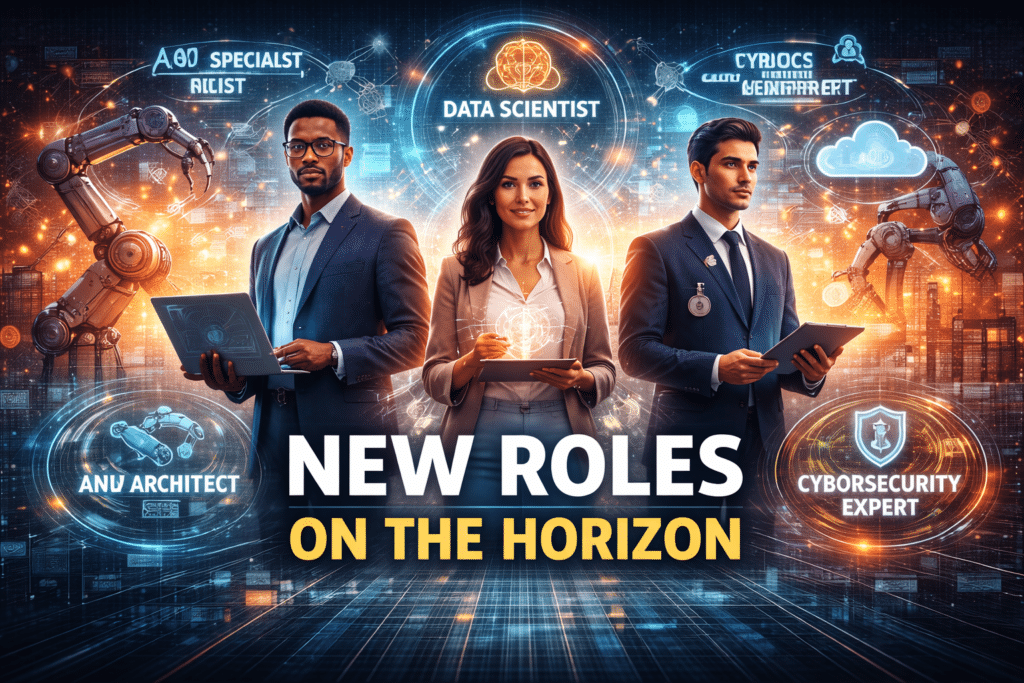
Job titles that weren’t previously available have begun to appear, due to the incorporation of artificial intelligence (AI) within the SAP landscape. As a result of this tech boom, there is now an increased need for employees with skill sets associated with this developing area:
- SAP AI/ML Solution Architect: These professionals act as a liaison between business processes and machine learning models in order to support the implementation of AI into an organization.
- SAP BTP Consultant: These are individuals who take advantage of SAP’s Business Technology Platform (BTP) to create extensions for existing SAP systems by utilizing generative AI technology.
- Predictive Analytics Consultant: While these consult with clients on the design and implementation of SAP Analytics Cloud (SAC), they also provide forecasting capabilities for clients through the use of SAC and predictive analytics capabilities.
The Essential Skillset for 2026
The knowledge level of a ‘standard’ SAP client is no longer sufficient for maintaining status quo; rather, this can be seen as beginning point for moving forward. Functional/technical combinations of employee skillset continue to be some of the top rewarding combinations in today’s market space. Here is some additional examples of what a Y2K innovative toolkit will consist of:
- SAP S/4HANA Competency – The introduction of S/4 HANA, as the major source of close to 100% of AI Innovation, has necessitated a greater level of knowledge surrounding this platform and more importantly what SAP’s “Clean Core” strategy means prior to attending any ERP Class SAP will educate on.
- Conversational AI Knowledge – Tools like SAP Joule are rapidly evolving within our organisations to shift from Human Interactions with ERP systems towards one of Digital Agents eg. AI Co-Pilot for SAP) and configuring and/or guiding how users will leverage their Digital Agents is becoming a significant Human Capital Development competency for any SAP Professional.
- Data Governance – The AI powered by poor data will reflect that in its decisions therefore mastering data modelling, data quality, will eliminate AI hallucinations that are going to happen with critical supply chain forecasting and decisions.
Why SAP Certification Still Matters
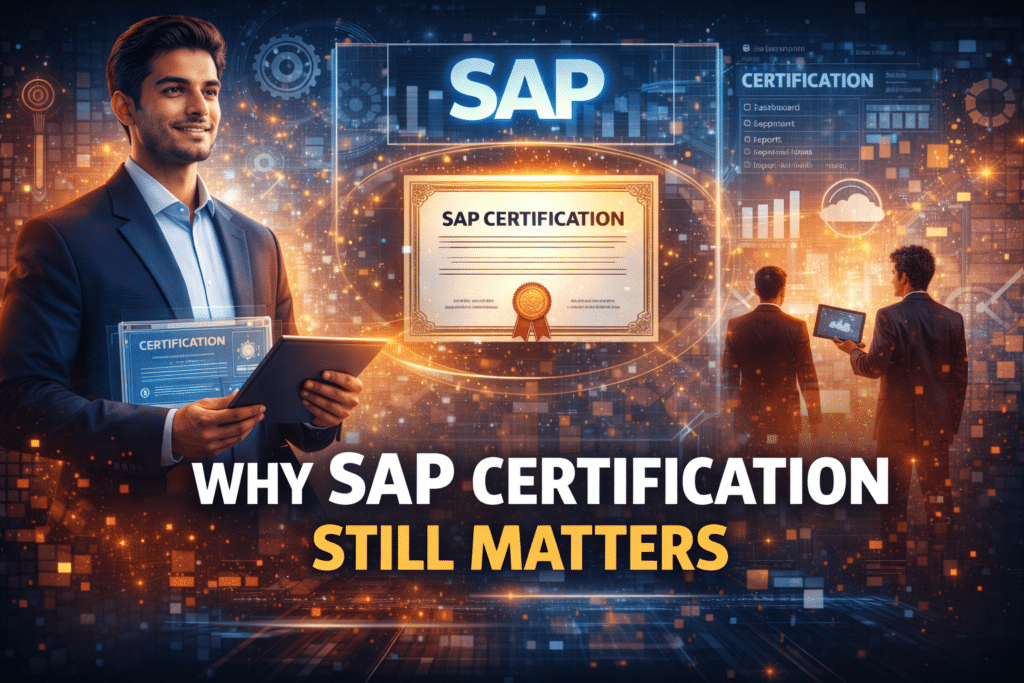
Many of you may be thinking to yourself, “Do sheets of paper carry any weight in today’s technological society?” Well, again I say, YES! The SAP Certification is a form of establishing a level of trust between the consultant and company. As organizations transition from on-premise to cloud (especially using RISE with SAP), organizations require proof that the consultant has knowledge of the new intelligent architecture. In addition to this, those who have both legacy module experience and an AI-specific certification can expect to have higher salaries than their legacy peers; typically from 20%-30%.
The Shift to “Agentic” ERP
As we head into 2026 onward, we will see organizations adopt what has been labelled by the experts as ‘Agentic’ ERPs. This will mean the system no longer waits for you to click a button, but starts operating as a colleague and working with you to perform your tasks. As an example, imagine if there was an AI agent that detected when a supply chain went down, analysed three different alternative suppliers, and then offered to you a recommendation before you had finished drinking your first cup of coffee.
The role of those who are tasked with consulting also changes from completing an activity to supervising the agent. Therefore you will become the manager and director of a complete digital workforce. To be successful in this new role will require a very different way of thinking than in the past, as you will be expected to perform more than just the technical aspect, but to also provide ethical oversight and strategic decision making to an agent.
Bridging the Gap: Your Roadmap
In order to secure a career for the long haul, you should:
- Obtain Certification: Aim to gain SAP Certification in cutting edge modules(S/4HANA Cloud, SAP BTP, etc).
- Get Practical Experience: Look for a full SAP training program to understand how to use AI in the real world as opposed to purely theoretical configuration skills
- Work On Your Soft Skills: AI cannot duplicate your interpersonal skills through effective communication and exhibiting empathy to others. The more sophisticated AI becomes, your ability to communicate complex technology in business-speak will be the most valuable asset you possess.
Conclusion
In the end we can say that the AI in SAP is not a replacement cycle it is an enhancement cycle. It invites us to stop being operators and start being innovators. While the tools are changing, the core mission remains which helps businesses run better, By embracing a modern SAP Course and staying curious about Generative AI, you will make sure that you are not just a witness to this transformatio but a leader of it.
To help you navigate this transition, Nextnow provides specialized training programs that is designed to bridge the gap between traditional ERP knowledge and the future of AI-integrated business processes. Whether you are a fresher or a seasoned veteran, the right guidance can turn the “AI threat” into your biggest career opportunity
FAQs
Will AI eventually replace SAP consultants?
Think of the AI as being your fast-working helper; it does not replace you. AI is very fast at doing calculations and identifying patterns however it lacks the human experience to go through office politics, know/understand a client’s unique business culture as well as make complex ethical decisions. The real value of an SAP professional in 2026 will be to act as a Business Transformation Partner. AI will do the configuration “grunt work” and you will do the Strategy and Relationship Management.
Do I need to learn how to code (like Python) to survive in SAP now?
Although you don’t have to become an expert coder, “technical literacy” is no longer an option. You need to learn about how AI models work together with the SAP Business Technology Platform (BTP). Most of the new SAP training programs now contain “Low-code/No-code” modules for developing AI enabled add-ons without having to create hundreds of lines of code.
Is a traditional SAP Course still worth it if the tech is changing so fast?
Understanding the essentials surrounding SAP is now more important than ever because AI requires a ‘Clean Core’ in order to function correctly. Without knowledge of the foundational business processes (such as Lead-To-Cash or Procure-To-Pay), one wouldn’t know whether the AI is sharing a valid Insight or producing Hallucination from data. Make sure when you’re looking for S/4HANA Cloud and SAP Business AI course content that the material serves as preparation for future SAP usage.
How does an SAP Certification help me in an AI-driven job market?
As Generative AI grows, anyone can call themselves an expert. An official SAP certificate (particularly the new performance based versions that will be introduced in 2026) shows prospective employers that you have real-world experience. Since companies are using certified professionals during their implementation of AI to help prevent their financial losses, there is a difference between saying you “understand AI”, and actually being able to “use AI in a SAP environment”.
What is “SAP Joule,” and should I be worried about it?
SAP’s AI co-pilot is Joule. Instead of clicking through many different screens to locate a report, you can simply ask Joule to show you the top 3 supply chain bottlenecks for Q1. This greatly increases the effectiveness of a consultant by providing them with an answer so quickly that they are able to spend more of their time resolving the business problem rather than searching for data.