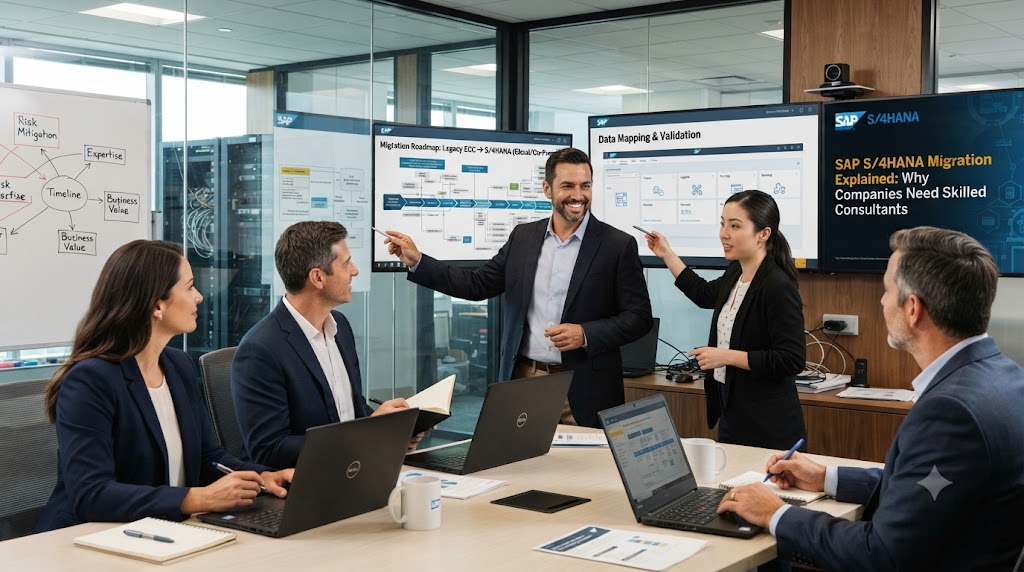


SAP S/4HANA Migration Explained: Why Companies Need Skilled Consultants
If you’ve spent the last two years near an IT roadmap meeting, you’ve undoubtedly heard “SAP S/4HANA migration” mentioned. It’s possible it just blended with the other tech jargon or appeared as a date, none could be happier to discuss. If it was one of the latter cases, rest assured…
This is not a minor update, install this on a Saturday afternoon! This represents a whole new paradigm shift in how business will operate around data, processes, and systems. That is why many organizations are calling in experienced consultants in an effort to gain a positive migration outcome rather than learning from experience.
What Exactly Is SAP S/4HANA Migration

SAP S/4HANA is SAP’s new generation of ERP software that utilizes the HANA in-memory database. An upgrade to S/4HANA is migrating the business’s ERP system away from the old SAP systems, whether this is ECC or R3, or even non-SAP, to the new HANA architecture. This involves more than a technical upgrade as it is often a business process re-engineering requirement, change in integrations and potentially the wholesale review of ways of working so that benefits of S/4HANA such as the real-time data available from day one, the simplified data model and a more innovative user experience can be harnessed.
Why This Migration Is Becoming Unavoidable for Businesses

SAP have laid down an unequivocal timetable and is pulling businesses off the legacy ECC system. If you’re still using the older version then you’re on the clock. And it’s not just about staying on board with SAP, there are compelling business drivers, including processing faster, more accurate reporting, stronger integration capabilities with cloud and AI services, and a system that’s made for how the modern business actually works. Wait to migrate and you’ll soon find yourself lagging behind competitors that have already realized those advantages.
The Three Common Approaches to Migration
As a whole, businesses have just 3 avenues from which to migrate to, get the wrong one and it can end up costing more…
- Greenfield – Starting from zero with a completely fresh implementation, perfect for companies that need a complete process overhaul.
- Brownfield – A system conversion that requires lifting-and-shifting the old setup over, quicker but less comprehensive.
- Bluefield (hybrid) – A middle-ground that allows companies to retain the old setup but only rebuild certain aspects of it.
Each path also carries differing costs in terms of capital required, impact to operations during the transformation, quality of data that needs to be wrangled, and flexibility for the future.
Why Migration Projects Go Wrong Without the Right Expertise
This is where the complexities start to rise. The amount of companies that don’t consider the pitfalls; Data Migration failure, Integration failure, understated user training requirements and business downtime, all with no real technical understanding of SAP data structures and the design of business processes, results in a technically “live” system that is virtually impossible to operate productively; and if done poorly this doesn’t only cost a lot of money it will disrupt the business for months, not days.
What Skilled SAP Consultants Actually Bring to the Table
That is where seasoned advisors add tangible value. We provide:
- Technical expertise: Understand migration tools, deal with legacy code and system architectures in the system to provide a technical solution in a standard way, or develop custom code where needed to fill the gap. Provide advice to optimize the old processes.
- Process expertise: Understand the changes the ERP system is expected to drive to optimize and re-engineer the existing business processes and workflows to effectively utilize the new system instead of replicating old processes.
- Risk management: Prepare a contingency plan for any unexpected issues during the migration, system rollout, and user adoption, and perform user tests to address the risks.
- Change management: Assist the organization in developing a change management plan for employees with different skill sets. Ensure a positive user acceptance for the new systems/processes by addressing their concern through various communications and training on the new functionalities.
This business consultant can be seen as more than just following a technical checklist, as in understanding the business objective, then translating it into a system that supports the business
Also remember, the skills listed above don’t just come about magically. Generally, top-tier consultants develop their skillset through traditional SAP Training courses, SAP Courses, and through respected SAP Certification that tests a candidate’s knowledge on individual S/4HANA modules as well as best practices. Whether a consulting partner has a team that actively goes through training and obtains certifications while looking to engage a consulting partner.
How to Choose the Right Migration Partner

A firm or consultant cannot always impress you just by a CV filled with the keywords and terms for the consultants to use, but you certainly want them to inquire about their knowledge in your industry, if they have performed data cleansing before, how do they manage custom code, what services are available after post go live and which are the certifications in which SAP Certification that their consultants are? SAP Training and SAP Courses training from other organizations have to be ongoing to help their consultants to keep pace with the change. It is also good to gauge for the most competent partner whether they approach a migration as a process that never ends on the day that a live system becomes accessible
Conclusion
SAP S/4HANA migration is likely the single most important technology decision your business will make this decade. It will impact how your employees work every day, and how your company compete into the future-and the cost of getting it wrong far outweighs the cost of getting it right the first time around. That is the value that experience brings. Nextnow helps you take this transition with the technical skill and strategic vision to make your migration seamless and, most of all, a truly game-changing experience.
FAQs
What even is an SAP S/4HANA migration, and why is everyone talking about it?
Think about it as tearing out your old, slow digital company infrastructure and swapping it for a brand new, high-speed sports car engine. Eventually, your legacy SAP system will hit its expiration date and you’ll have to do some housekeeping.
Why can’t our own IT department just handle it?
Think of your IT team like your family doctor; they’re wonderful for day-to-day well-being. However, for open-heart surgery you’re not visiting your local clinic. S/4HANA migration, quite simply, is open-heart surgery.
What makes SAP S/4HANA migration a strategic business transformation rather than a routine IT patch?
S/4HANA offers better data structures (like the Universal Journal) and real time analytics. If business processes are not harmonized, there is no automation possible and no intelligent or predictive insights. There is nothing done more quickly.
How do skilled consultants optimize the timeline and total cost of ownership (TCO)?
The use of established project frameworks (SAP Activate, automated custom-code remediation tools – ABAP Test Cockpit, and data cleansing processes) has been practiced by senior consultants to control scope creep and speed-to-value.