

Why Project-Based SAP Learning Outperforms Certification-Only Learning
Have you ever Googled “how to learn SAP” and noticed the avalanche of ads claiming that you can get a certificate in just a few weeks? Indeed, certifications are impressive on a CV and, in fact, are typically one of the first items that will catch a recruiter’s eye. The inconvenient truth is that while it proves you passed a test, a certificate does not in itself prove you can do a job.
The distinction between “knowing the theory” and “being able to perform the work” is precisely why project-based SAP training is increasingly the study choice for those serious about learning and precisely why companies are placing a higher and higher value on such learning compared to just a stack of certifications.
In this blog, we will talk about Why Project-Based SAP Learning Outperforms Certification-Only Learning.
The Limitation of Certification-Only Learning

SAP exams are constructed with repeatable content. You’ll learn a body of knowledge, practice how to configure SAP, spend countless hours working on MCQs and then you’ll do the exam. There is value here too – getting basic vocabulary in order; solidifying what the general concepts are about.
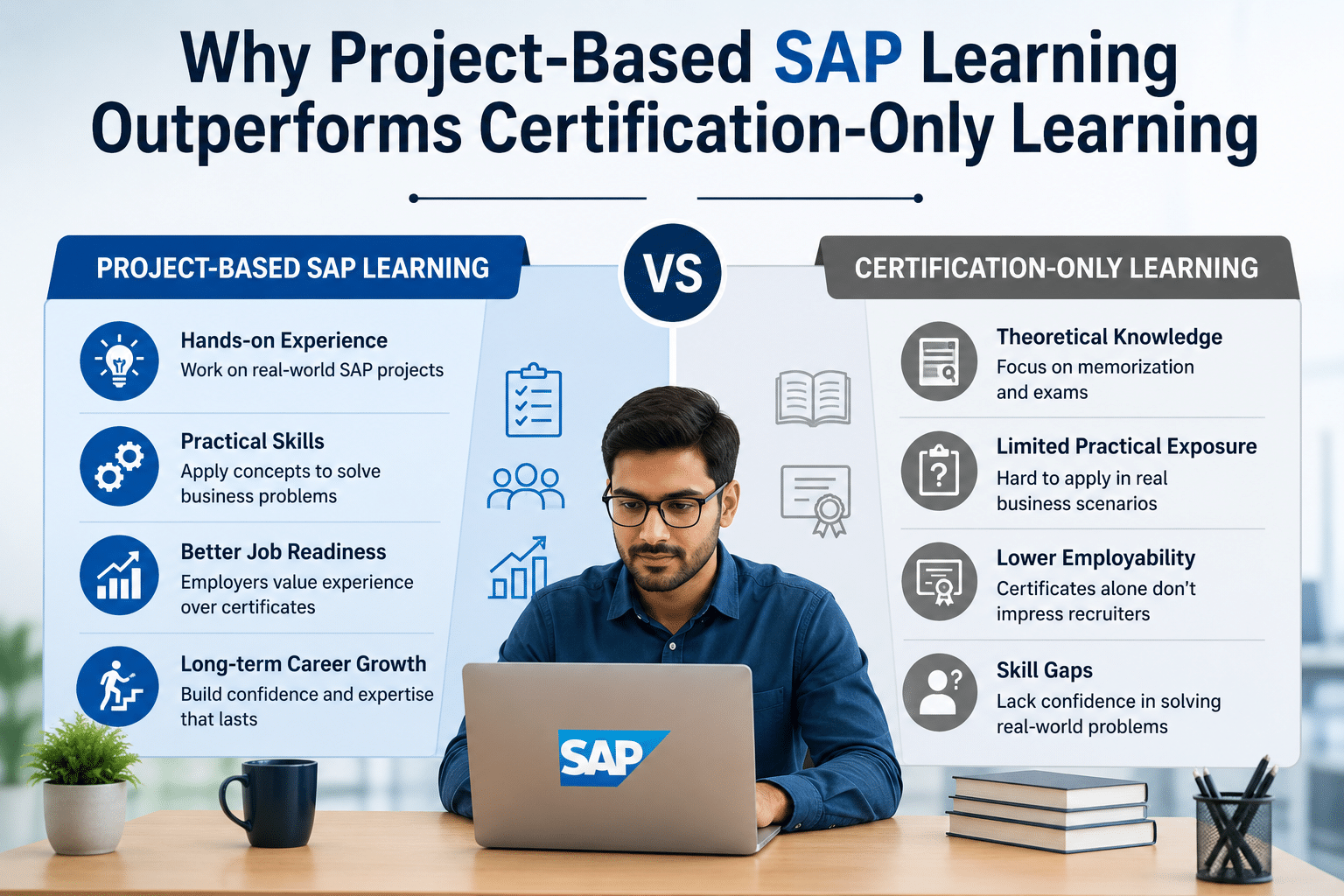
Certifications help you understand the topics really well. Understanding a topic and then applying it in a real-world use case is very different. Project-based learning will help you to apply the learned concepts to understand their working in real world problems.
People can pass the certifications easily but are not able to configure the system according to the demands of the customer. This is where they lack the real understanding and approach towards the problem.
So what Project-based learning looks like for SAP

A project-based SAP course has the positions flipped. Instead of studying the concepts in the book and assuming that some of them are understood and stick, you apply yourself to solving business problems such as starting procure-to-pay cycles, whole order-to-cash processes and migrating master data as you learn the concepts through their implementation.
This of course emulates consultancy. A customer does not give a consultant a chapter from a book in order to help that consultant solve the problem at hand. A customer gives a consultant a requirement and they have to configure the system to fulfill the requirement, test the solution, it breaks, you then fix it and document it. This is what the project-based learning approach builds into your muscles.
Why do project-based learning methods outperform certification training purely?

1. It is focused on actual, real problem-solving issues
As soon as you try to set up the end-to-end process on your own, you will stumble across problems, missing settings, and incorrect master data. Correcting those yourself, it teaches you so much more than reading anything from a slideshow. Project-based learning will slowly develop the right understanding and enhance your approach towards the behavior of the SAP systems.
2. Increases the chances of resume shortlisting
Employers are looking for resumes that mention projects on them. Those who have projects listed on the resume are picked much earlier than those who have only mentioned the certifications.
3. Project-based learning is real evidence
Project-based learning brings out confidence in your understanding of SAP. It is real evidence for employers to test your skills. Learning through projects will give you more advantage than other candidates. It teaches you real-world scenarios and certification only enhances your knowledge of the concept.
4. It prepares you to perform under pressure.
You don’t see this when you ask any senior consultant what you should memorize from your textbook when you have to take the next client call. Students working with an open-ended design thinking project learn very quickly and naturally that they are comfortable with uncertainty.
5. It is much more sticky.
Anyone who has ever gone through a process of struggle and perseverance trying to make a concept work has experience that has truly engraved the concept into the brain in a more fundamental way than simply reading a fact for a quiz.
Some of the Common Projects used in the SAP Learning
| Different projects to study | SAP modules used for Projects |
| Procure-to-Pay (P2P) | MM (Materials Management), FI |
| Order-to-Cash (O2C) | SD (Sales & Distribution), FI |
| Record-to-Report (R2R) | FI-CO |
| Plan-to-Produce (P2M / Production Planning) | SAP PP, MM |
| Hire-to-Retire (H2R) | SAP HCM / SuccessFactors |
What employers are looking for in SAP
The project-based SAP course has more advantages than certification in an interviewer’s eyes. Project-based learning makes you understand the concepts completely from scratch and deal with real-world problems. You apply yourself to solving business problems such as starting procure-to-pay cycles, whole order-to-cash processes and migrating master data as you learn the concepts through their implementation.
A customer does not give a consultant a chapter from a book in order to help that consultant solve the problem at hand. A customer gives a consultant a requirement, and they have to configure the system to fulfill the requirement and test the solution. If it breaks, you then fix it and document it. This is what the project-based learning approach builds into your muscles.
Here’s why recruiters and hiring managers look for demonstrable project-based, applicable experience instead of just a certification. It’s basic supply and demand, really. Your certificate demonstrates what you learned. Your projects show them what you will produce.
A certificate holder would know and understand how an SAP can address any problem, yet a candidate with hands-on involvement in an SAP project would know how to pinpoint the issues, address the underlying causes, and resolve the issues successfully.
Should you go for Certification or Not?
Certification is not entirely useless. You should definitely go for certifications. It might certify your basic knowledge and some organizations will use it as an initial screening tool for job applications. The best strategy is not “one or another”. It’s project-based learning on a lower level to achieve basic knowledge and certification is something you add when you know how it’s done with practical experience.
Consider it like this: Certification means you know the rules of the game. Project-based experience means you can play it.
The Bottom Line
It’s not the people who can provide theoretical knowledge employers want to hire; it’s the people who can bring SAP solutions and expertise to actual, ongoing business problems. Project-based SAP training will help you to gain tangible skills and hands-on troubleshooting experience. You can counter situations that are not based on textbook knowledge. You will be able to solve real-world issues that arise on a daily basis.
Break something. Then, fix it. That’s how you truly learn SAP and provide something tangible and valuable to future employers.
Nextnow is a top institute that provides the best project-based learning certification training. The faculty members are industry professionals who have worked in the field and are willing to teach real-world problems through different projects.
Contact Details
Company name – Nextnow
Phone no – +1 365-341-2985
Email ID – admin@nextnow.ca
Address – 2 County Court Boulevard, Suite 400, Brampton, ON, L6W 3W8, CANADA
Frequently Asked Questions
Where can I get the project-based SAP learning in Canada?
Nextnow is a reputed institute that provides project-based SAP certifications.
Is SAP Certification useless if I do project-based learning?
No. Certification will prove the baseline skill level to pass the screening of the resumes. It is suitable when supplementing it with project work and not replacing project work with it.
Should I do more than two or three SAP projects before applying for a job?
Yes. Two or three end-to-end projects based on various processes (like P2P & O2C) is sufficient for an entry-level fresher and this will be more than enough for taking up projects as and when they are faced.
I don’t work for a company and I don’t have access to a corporate SAP system. Where can I practice SAP projects?
Most students practice on an SAP training system. You can test a trial through SAP Learning Hub, on guided project training courses for real project configuration in a sandbox, etc.
How can I present project experience without working in an actual company yet?
You can record your practice projects: what you have configured, problems, solutions, etc., which will present a portfolio to employers in an interview or on LinkedIn.
Can I get a job with certification and no project experience?
You will get an SAP position with a certificate and no project experience. It is possible, but it’s becoming harder and harder now. Employers will raise several scenario-based questions during the interview, which require much practice.